Wednesday, February 27, 2008

Shout out to the Hellebores


Lets give a shout out to the lonely hellebore. Holla....Hellebore.


Out there in our gardens in the freezing cold without even a jacket to keep them warm. Hellebores are basically easy to grow. Most prefer woodland conditions with deep, fertile, humus-rich, well-drained soil and dappled shade, but they're very tolerant of a wide variety of soils and situations as long as they have good drainage and are naturally very long-lived. Although many hellebores perform best in alkaline soil, they’ll usually do just fine in neutral to slightly acidic conditions. Feed them once or twice yearly. Once established, they do not appreciate being moved - they will sometimes take a few years to get re-established following transplanting. Some are also known for freely self-sowing and colonizing when happy. Though if you have more than one type of hellebore in close proximity the offspring may not resemble their parents. I've had some seedlings I received in a plant swap that have survived and grown in almost pure sand at my gardens at home so I can attest to what a tough little plant this is.


We carry a varied selection of them here at Big Bloomers. We have recently added 'The 'Mardi Gras' series. This series boasts exquisite colors and slightly larger flowers carefully hybridized by hellebore guru Charles Price making them truly the big brothers of the genus.


'Mardi Gras White'


'Mardi Gras Black'


'Mardi Gras Pink'


'Mardi Gras Red'

We have also added to our 'Schiemann Strain lady collection' with some lovely 'spotted ladies' as well as a new Metallic Blue lady with a pewter sheen and large bowl-shaped flowers of rich purplish-blue. Beautiful and easy to grow. Isn't she a sight for cold eyes.


Another addition to this series is the lovely 'picotee pink'


Friday, February 8, 2008

A Perfect Picture


One of the best things about working at Big Bloomers has to be the customers.

These gorgeous pictures were taken by one of them.

Sunday, February 3, 2008

PERENNIAL FOUR PACKS (BE STILL MY HEART)

Tomorrow I will take advantage of this lovely bit of weather and plant this sweet little box of foxglove.


This time of year always sends me into a bit of a tizzy. We offer so many lovely perennials in four packs and I always have to have them all.


This is a four pack.


You get four for the price of one and since perennials are better planted in groups you get a nice bang for your buck. The seedlings are sown in the greenhouses starting early winter. Some will take a couple of years to get to their true size. These though, will bloom and grow to full size in one season.

We have a varied selection of perennials in four packs including campanula, alcea, digitalis, aquilegia, various grasses and herbs. I could go on and on but maybe you should come and see for yourselves. The digitalis, aquilegia and some others are hardy to zone 4 and being so are fine planted this time of year in the south.

These are pictures of one of my gardens photographed in May, that was planted early February with the same amount of digitalis that I will be planting today.


Saturday, January 26, 2008

Plant of the Moment-Prostanthera Rotundifolia (Australian Mint Bush)


I first noticed Australian Mint Bush in our greenhouses two springs ago. If I remember correctly it was very early spring, maybe late March or April. I was walking through the herb greenhouses to get to a greenhouse on the back of the property and noticed a lilac haze that stopped me in my tracks.

Native to Australia and Tasmania, prostranthera rotundifolia has tiny, ovate, very fragrant, evergreen leaves. In our greenhouses they tend to take on a standardized look very quickly from stem cuttings and lend themselves very well to that look. I have also seen them closely sheared much like a boxwood to great advantage also. With its lovely fragrance what a sweet chore shearing them would be. The Australian aborigines used the leaves in an infusion for relief of headaches and colds. The small mint flavored leaves are also used for culinary purposes in place of thyme and for potpourris.

A small plant transplanted that spring into a large pot on my back deck soon grew to about five feet. Since we show it being hardy to zone 9 I brought the huge pot inside an unheated back room to winter over. It survived just fine though it did get a bit leggy that winter. I was disappointed the following spring when it failed to bloom.

While bringing tender plants in this fall I decided it really wasn't worth the room in the small area I use to overwinter plants so I placed the pot up against the side of my house in a southeastern exposure thinking I would pull the dead plant out and plant something else in the large pot this spring. While working outside this past weekend I was very pleased to discover that it has survived some very cold nights into the teens and still remains green. If it survives the rest of the winter and blooms this spring I may very well rethink its worthiness and plant a couple more. For this reason prostanthera rotundifolia is my plant of the moment.

Sunday, November 25, 2007

Christmas Open House

Even this time of year is a busy time for us here at Big Bloomers. After the quick Halloween, fall and Thanksgiving seasons there is a big flurry of decorating to get ready for our Christmas Open House. I managed to sneak a few videos and pictures in before friends and customers showed up Sunday morning. Thank you Jo for all your hard work, wonderful refreshments and lovely company.


Don't forget to check out our Christmas store 'Beyond the Garden Gate' located in the Riverbirch Shopping Center. There we offer a variety of holiday decor as well as select holiday plants, candles, gifts and stocking stuffers.

Plant of the Moment-Barleria cristata (Phillipine violet)

Barleria cristata (Phillipine violet) is not a violet at all. Belonging to the acanthus family Barleria cristata is not even native to the Phillipines but rather to India and Myanmar. This shrub-like perennial grows strongly upright to 2-3 feet. It is a lovely, undemanding and drought tolerant plant with handsome foliage. It will grow in full to part sun. In our southern climate it seems to be happier in morning sun.

I planted one in a 4" pot from our semi-sun section in early spring. I potted it up in a large pot where it bloomed all spring. With the heat of the summer months it stopped blooming but was still a very nice specimen plant. In late September it started blooming again. I planted it in the ground a little while later and was pleasantly surprised a couple of days ago when I noticed it had put on its fall coat of many colors. I have read they are very easily propagated by planting a sprig in moist soil. In my mind's eye I am seeing a lovely hedge row of them in all their fall glory somewhere on my property. For this reason it is my "plant of the moment".


Thursday, November 8, 2007

Plant of the Moment... A Tale of Two Tagetes


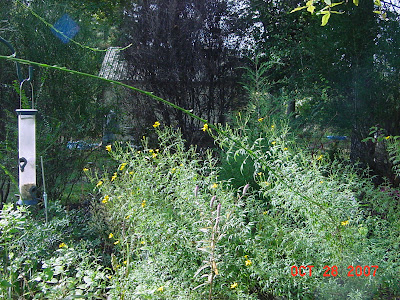
The plants of the moment have to be the two tagetes blooming in our herb gardens now. They will both bloom into December and for that quality alone they both deserve to be plant of the moment.

Tagetes lemmonii is a wonderful, sprawling shrub-like plant with airy, delicate foliage. Late in the season and especially while blooming it can be a thug, falling over whatever is growing near it. Its such a delicate plant though that it doesn't seem to smother things like the late asters and chrysanthemums can sometimes do. People refer to it as "fragrant". Most people I know think it stinks. It is on the stinky side. Brush against it anytime of the year and you will certainly smell it.

Tagetes lucida on the other hand is more of an upright, orderly and sweetly fragrant plant. This one requires more of a "brushing against" to enjoy the fragrance, but crush a leaf or a stem and you will certainly be rewarded.

I love them both. They bloom this time every year oblivious to freezing temperatures when most other perennials have said goodbye to summer. I have planted them in most of my gardens... one because of its scent and one in spite of it.